Grain Basis Explained: Why Your Silo Price Differs
You check Euronext. Wheat shows €210/t. You call your grain buyer. He quotes you €195/t. Those 15 euros that evaporate between the screen and your silo are what the trade calls the basis, and understanding it changes the way you sell your grain for good.
You check Euronext. Wheat shows €210/t. You call your grain buyer. He quotes you €195/t. Those 15 euros that evaporate between the screen and your silo are what the trade calls the basis, and understanding it changes the way you sell your grain for good.
What exactly is the basis?
The basis is the difference between the local cash price; the one you actually receive, and the futures price quoted on an exchange such as Euronext Paris (MATIF) or Chicago (CBOT).
Basis = Local cash price − Futures price
A negative basis (−€15/t in our example) is the norm in grain markets. It reflects every cost and constraint that stands between your silo and a standardised exchange-traded contract.
Why does the gap exist?
The basis is not a sleight of hand by your grain buyer. It is the sum of several very concrete economic realities.
Freight cost is the most obvious component. Physically moving your wheat to an export port or a flour mill burns diesel, time and labour. A grower in the Beauce will enjoy a better basis than a colleague in the Massif Central, simply because geography cuts the logistics bill.
Quality and specification also play a decisive role. The Euronext contract covers a standard wheat defined by a precise specification; protein content, Hagberg falling number, specific weight. If your crop differs from that standard, the basis adjusts up or down.
Trade margins along the chain are built into the spread too. Grain buyers, exporters and processors work on thin but real margins. Those intermediaries are what turn your physical tonne into a financial position on organised markets.
The local delivery premium finally reflects supply and demand in your own catchment area. When local silos are full and selling pressure is heavy, the basis weakens. When local industry needs cover urgently, it can tighten sharply.
The basis moves, and that is your opportunity
Contrary to what many growers believe, the basis is not fixed. It shifts through the season according to several factors you can anticipate.
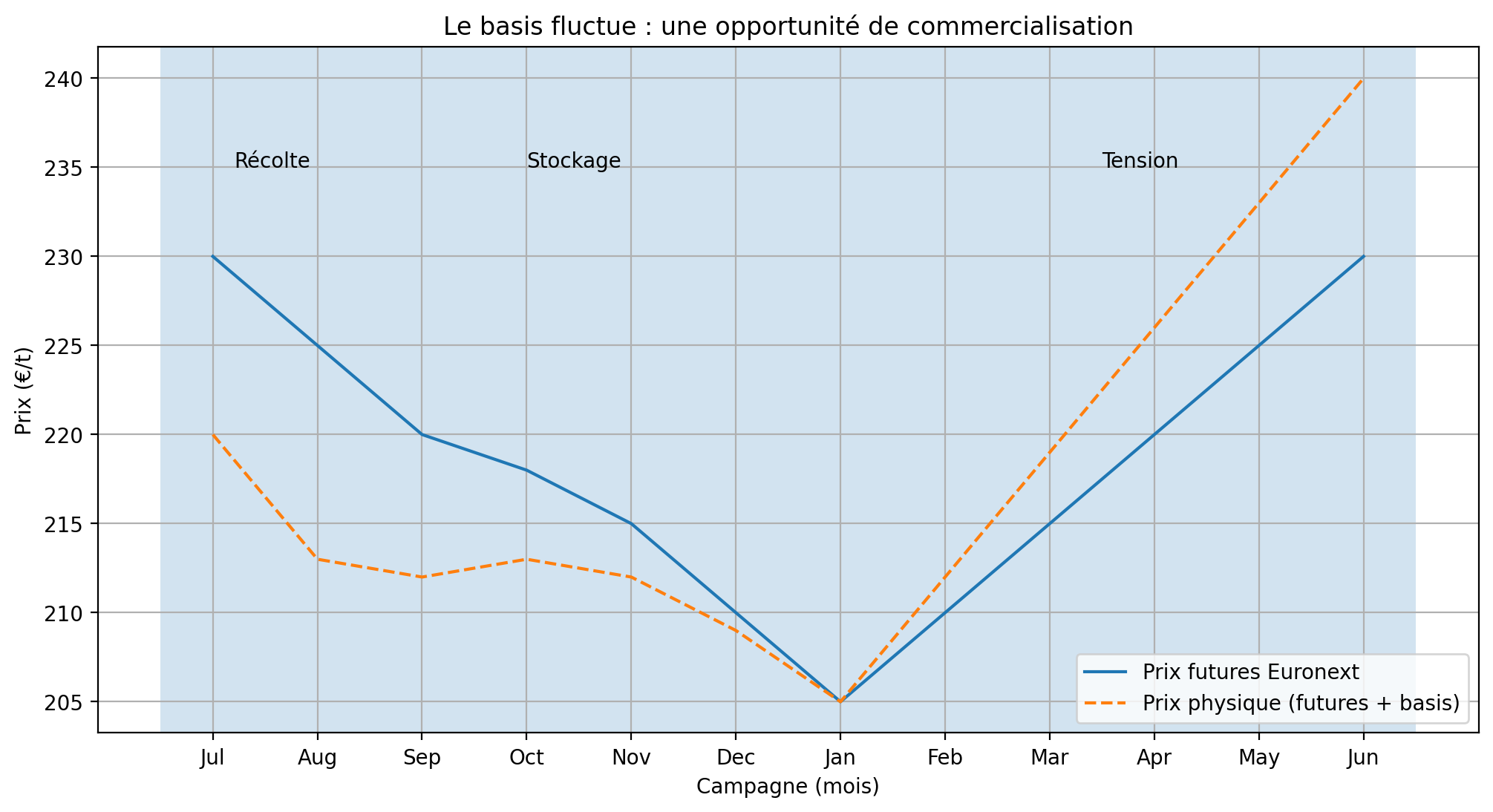
Early in the season (July-August), selling pressure peaks. Co-ops and merchants are keen to take in grain quickly, but silos fill fast. The basis is often at its weakest. This is when many growers sell out of reflex, and often at the wrong time.
Through the season, as physical stocks draw down and industrial demand holds up, the basis tends to tighten. Anyone able to store on farm or in silo can capture that improvement.
Late in the season, tightness in available supply can produce exceptional premiums. Mills and exporters short of raw material are willing to pay up to secure cover.
How do you use the basis in your selling strategy?
The first step is to track your own basis history. Each week, note the Euronext quote and the price offered by your main buyer. Over two or three seasons you will spot recurring patterns: the periods when the basis is historically favourable, and those when it systematically weakens.
The second step is to separate the two decisions. Selling on the exchange (fixing the futures price) and selling physically (delivering the grain) are two distinct acts. A well-informed grower can fix the Euronext price when the quote is attractive, then wait for the basis to improve before closing the cash sale. This technique, known as deferred pricing, requires working with a buyer who offers that kind of service.
The third step is to anticipate the events that move the basis. A bearish USDA report will knock Euronext down but will not immediately affect the local demand of your regional miller. In that case the basis improves mechanically: an opportunity for cash sellers.
The basis in 15 years: a constant
Globalised agricultural trade, the digitalisation of markets, the rise of online broking, none of it will make the basis disappear. As long as physical wheat has to travel, meet quality standards and pass through intermediaries, the gap between the screen price and the silo price will exist.
What can change is your ability to read it, anticipate it and turn it into a lever rather than a fact of life. Growers who outperform their neighbours over the long run are not necessarily the ones who forecast world markets better, they are usually the ones with a better grip on their local basis.
Understanding the basis means taking back control of the part of the price you can actually influence.